The field of molecular computing has emerged as one of the most fascinating frontiers in modern technology, blending chemistry, biology, and computer science into a revolutionary approach to information processing. Unlike traditional silicon-based computers that rely on electronic signals, molecular computing harnesses the inherent properties of molecules to perform calculations, store data, and even make decisions.
At its core, molecular computing represents a paradigm shift in how we think about computation. Where conventional computers manipulate binary digits (0s and 1s) through transistors, molecular computers utilize the complex interactions between molecules to process information. This biomimetic approach offers several intriguing advantages, including massively parallel processing capabilities and energy efficiency that could potentially dwarf today's supercomputers.
The origins of molecular computing can be traced back to visionary scientists like Leonard Adleman, who in 1994 demonstrated that DNA molecules could be used to solve computational problems. His groundbreaking experiment solved a seven-node Hamiltonian path problem using DNA strands, proving that biological molecules could indeed perform computations. This seminal work opened the floodgates for research into alternative computing paradigms that could overcome the limitations of Moore's Law.
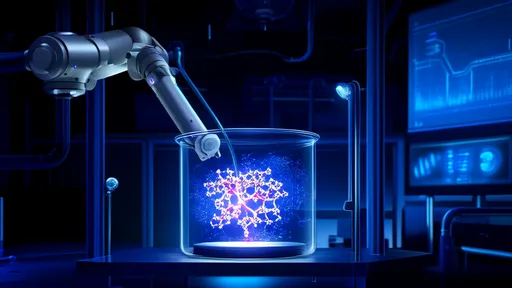
Modern molecular computing research explores various approaches beyond DNA computing. Some laboratories focus on using proteins, enzymes, or even entire cellular structures as computational elements. Others investigate synthetic molecules designed specifically for information processing tasks. The common thread is the exploitation of molecular properties - their shapes, binding affinities, or chemical reactions - to represent and manipulate data.
One particularly promising avenue involves molecular logic gates, analogous to the logic gates in electronic computers but constructed from carefully designed molecules. These molecular gates can perform AND, OR, and NOT operations based on chemical inputs and outputs. When combined into more complex circuits, they could theoretically perform any computation that conventional computers can, but with potentially greater efficiency and in much smaller physical spaces.
The potential applications of molecular computing are as diverse as they are transformative. In medicine, molecular computers could operate within the human body, detecting disease markers and releasing targeted therapies. Environmental monitoring could be revolutionized by distributed networks of molecular sensors that detect pollutants at incredibly low concentrations. Even cryptography stands to benefit from molecular approaches that could create unbreakable codes based on chemical complexity.
However, significant challenges remain before molecular computing can move from laboratory curiosities to practical technologies. Controlling molecular interactions with sufficient precision for reliable computation remains difficult outside carefully controlled environments. The speed of molecular computations, while potentially massive in parallel, often lags behind electronic computers for sequential tasks. Moreover, interfacing molecular systems with traditional electronics presents engineering hurdles that researchers are still working to overcome.
Recent breakthroughs have brought molecular computing closer to practical reality. Scientists have demonstrated molecular systems capable of simple machine learning tasks, pattern recognition, and even playing basic games. Some research groups have created hybrid systems that combine molecular components with conventional electronics, potentially offering a transitional path toward full molecular computers.
The energy efficiency of molecular computing deserves special attention. As the world grapples with the enormous energy demands of data centers and supercomputers, molecular approaches offer the tantalizing possibility of computation with minimal power requirements. Many molecular computations occur at or near thermodynamic limits of efficiency, potentially reducing the carbon footprint of information technology by orders of magnitude.
Looking ahead, the field faces both exciting opportunities and daunting challenges. Scaling up molecular computing systems while maintaining reliability will require innovations in molecular design, error correction, and system integration. The interdisciplinary nature of the field means progress depends on collaboration between chemists, biologists, computer scientists, and engineers - a cultural challenge as much as a technical one.
Ethical considerations also come into play as molecular computing advances. The potential for self-replicating molecular computers raises questions about control and safety. The military applications of such technology could be both promising and concerning. And the intellectual property landscape for molecular computing patents is already becoming complex and contentious.
Despite these challenges, the fundamental appeal of molecular computing remains strong. The ability to harness the information-processing capabilities that evolution has refined over billions of years offers a path to computing that is more aligned with nature's own methods. As research continues to advance, we may be on the cusp of a new era where computers don't just simulate life - they incorporate its very building blocks.
The coming decades will likely see molecular computing finding niche applications before potentially transforming entire industries. Early uses might include specialized sensors or medical diagnostics, with more general-purpose molecular computers emerging later if the technical hurdles can be overcome. What's certain is that molecular computing will continue to push the boundaries of what we consider possible in information technology.
For researchers in the field, each day brings new discoveries and surprises. The complex behavior of molecules often leads to unexpected computational capabilities that no human engineer would have designed from scratch. This emergent complexity is both the challenge and the promise of molecular computing - a reminder that sometimes nature's solutions surpass our own imaginations.
As investment in molecular computing grows from both public and private sectors, the pace of innovation is accelerating. Major technology companies have begun exploring molecular approaches, and startups are emerging to commercialize specific applications. The academic world continues to produce fundamental advances that push the entire field forward.
The story of molecular computing is still being written, but its potential to reshape our technological landscape is undeniable. Whether it ultimately supplements or supplants traditional computing remains to be seen, but one thing is clear: the molecules around us contain untapped computational power waiting to be harnessed. The scientists working to unlock that power stand at the frontier of what may be the next revolution in how we process information and understand computation itself.

By /Aug 15, 2025

By /Aug 15, 2025

By /Aug 15, 2025
By /Aug 15, 2025

By /Aug 15, 2025
By /Aug 15, 2025

By /Aug 15, 2025

By /Aug 15, 2025
By /Aug 15, 2025

By /Aug 15, 2025

By /Aug 15, 2025

By /Aug 15, 2025
By /Aug 15, 2025

By /Aug 15, 2025
By /Aug 15, 2025
By /Aug 15, 2025

By /Aug 15, 2025

By /Aug 15, 2025
By /Aug 15, 2025
By /Aug 15, 2025
