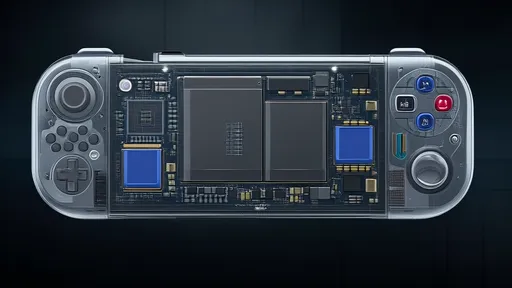
The concept of energy balance in handheld gaming devices has become increasingly critical as consumers demand longer battery life without sacrificing performance. With the rise of mobile gaming and hybrid consoles like the Nintendo Switch, engineers face the challenge of optimizing power consumption while delivering immersive experiences. The energy balance equation isn't just about battery capacity—it's a complex interplay between hardware efficiency, software optimization, and thermal management that determines whether a device will overheat after thirty minutes or provide all-day gameplay.
At the heart of every handheld gaming system lies a fundamental tension between performance and power draw. Modern processors capable of rendering high-definition graphics at 60fps can drain a 4000mAh battery in under two hours if left unchecked. Manufacturers employ dynamic clock scaling, where the CPU and GPU frequencies adjust in real-time based on workload. This technique alone can improve energy efficiency by 30-40% compared to fixed clock speeds, though it requires sophisticated algorithms to prevent noticeable performance drops during intensive gameplay sequences.
Thermal design power (TDP) specifications often tell only half the story. While a chip might be rated for 15W TDP, actual power consumption fluctuates dramatically based on workload characteristics. Games heavy on physics calculations stress different processor components than those focused on texture streaming. The most efficient handhelds implement per-core voltage regulation and memory bandwidth throttling to match these varying demands. Some devices even incorporate machine learning models that predict power needs based on the game being launched, pre-allocating resources before the title screen appears.
Display technology represents both the greatest power hog and most promising area for efficiency gains. OLED panels have largely replaced LCDs in premium handhelds due to their ability to disable individual pixels for true blacks, reducing power draw by up to 25% in dark scenes. However, refresh rate variability introduces new challenges—a system might save energy running at 40Hz for a cinematic adventure game but require full 120Hz output for competitive shooters. The latest devices employ dynamic refresh rate switching synchronized with frame delivery to eliminate wasted refresh cycles.
Battery chemistry advancements have plateaued in recent years, forcing designers to innovate in charging protocols instead. Modern handhelds utilize adaptive charging curves that consider both immediate usage patterns and long-term battery health. Some systems momentarily pause charging during intensive gameplay to reduce thermal stress, then resume when activity lessens. Wireless charging introduces additional inefficiencies, with the best implementations losing only 15-20% of energy in transfer compared to 30% in early iterations.
The software layer's role in energy balance cannot be overstated. Background processes like achievement tracking, voice chat, and automatic updates can collectively consume as much power as the game itself. Leading platforms now feature granular process scheduling that defers non-critical tasks until the device senses it's docked or charging. Some operating systems even analyze gameplay patterns—pausing cloud saves during boss fights when the player needs maximum performance, then syncing during inventory management screens.
Perhaps the most underappreciated aspect involves the player's own behavior patterns. Brightness preferences, controller rumble intensity, and even audio volume create measurable differences in battery life. Some manufacturers have begun incorporating "eco mode" tutorials that teach users how small adjustments can extend play sessions. The most sophisticated systems adapt to individual habits—if a player consistently engages in 45-minute sessions, the device might prioritize different power strategies than for someone who plays in 4-hour marathons.
Looking ahead, the next frontier involves contextual awareness. Experimental handheld prototypes can now detect whether they're being used indoors or outdoors, adjusting power delivery based on ambient light conditions without user input. Others modify performance when detecting movement (like on a train) versus stationary use. These innovations point toward a future where energy balance becomes so finely tuned that players may never need to think about battery life—the ultimate triumph of engineering over physics constraints.
The energy balance equation ultimately represents a series of compromises and innovations that most players will never see but all will experience. From the quantum tunneling effects in nanometer-scale transistors to the macro-level decisions about cooling vent placement, every design choice ripples through the power consumption profile. As handheld gaming continues bridging the gap between mobile convenience and console-quality experiences, these invisible optimizations will determine which devices thrive in an increasingly competitive market.

By /Aug 15, 2025
By /Aug 15, 2025
By /Aug 15, 2025

By /Aug 15, 2025
By /Aug 15, 2025

By /Aug 15, 2025
By /Aug 15, 2025
By /Aug 15, 2025

By /Aug 15, 2025

By /Aug 15, 2025
By /Aug 15, 2025

By /Aug 15, 2025

By /Aug 15, 2025

By /Aug 15, 2025

By /Aug 15, 2025

By /Aug 15, 2025
By /Aug 15, 2025

By /Aug 15, 2025

By /Aug 15, 2025

By /Aug 15, 2025
